
WELCOME BONUS 300%
UP TO €2000 + 100
FREE SPINS
UP TO €2000 + 100
FREE SPINS
Home → Roulette
Roulette at King-Billy
La Partage Halves Loss on Zero
French Roulette with La Partage offers a reduced house edge on even-money bets, standing at 1.35%. This compares favourably to the standard European Roulette's 2.70% house edge. The rule specifically applies when the ball lands on zero, returning half of the stake on bets like Red/Black or Odd/Even.
The La Partage rule is a significant advantage for players focused on even-money wagers. Unlike the standard French Roulette where the house edge remains 2.70% on inside bets, this feature directly benefits players on specific outside bets. This makes it a more player-friendly variant for those betting on outcomes such as Red/Black, Odd/Even, or Low/High.
For players utilising even-money bets in French Roulette, this mechanism effectively lowers the theoretical loss over time. With an RTP of 98.65% on these specific bets, it represents a substantial improvement over the standard 97.30% RTP found on other roulette variants. This reduction in the house advantage can lead to longer play sessions.
What Straight, Split, and Street Practically Mean
A 'Straight' bet in Roulette covers a single number on the wheel, offering a payout of 35:1. For example, betting on number 17 and winning would result in a return of 35 times the stake, plus the original wager. This is a high-risk, high-reward bet, common across various roulette types.
The 'Split' bet involves wagering on two adjacent numbers, typically paying 17:1. A 'Street' bet covers three numbers in a horizontal row, with payouts at 11:1. These bets offer a middle ground in terms of risk and reward compared to single-number or outside bets.
These betting options are fundamental to the Roulette game, available on standard European and French wheels. For instance, a European Roulette wheel with its 37 pockets provides these betting opportunities. The payouts remain consistent regardless of whether La Partage is applied, as that rule only affects even-money bets.
European Wheel with 37 Pockets Explained
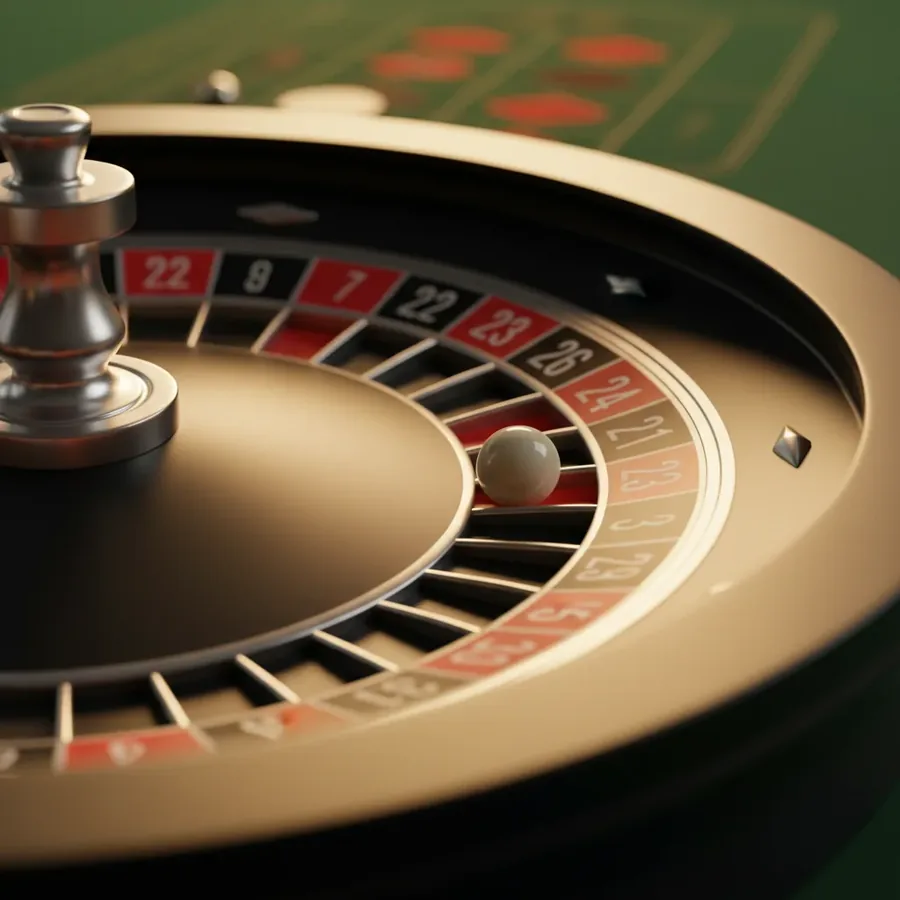
The European Roulette wheel features 37 pockets, numbered 1 through 36, plus a single zero (0). This design results in a house edge of 2.70% on all bets placed. The payout structure is based on 36 numbers, meaning the single zero creates the inherent advantage for the house.
With 37 sectors, the European wheel offers a standard RTP of 97.30% across its various betting options, including Straight (35:1), Split (17:1), and Column (2:1) bets. This contrasts with the American variant, which includes an additional '00' pocket, increasing the house edge significantly.
This configuration ensures a consistent house edge across all wagers, unlike some variants where specific bets carry a higher edge. For example, French Roulette (La Partage) modifies the edge on even-money bets, but the fundamental 37-pocket European wheel still forms the basis of play.
Statistics: 2.70 Percent of Every Bet
The house advantage in European Roulette stands at 2.70% on every bet placed. This figure represents the theoretical average amount the casino expects to retain from all wagers over the long term. For instance, on a 100 EUR bet, the house expects to keep 2.70 EUR.
This 2.70% house edge is a direct consequence of the wheel's configuration, which includes 37 pockets with a single zero. This is a standard figure for European Roulette, providing a consistent statistical advantage for the casino on all betting types, from inside to outside bets.
Understanding this statistic is crucial for players aiming to manage their bankroll effectively. While individual outcomes vary, this percentage highlights the inherent mathematical advantage the casino holds. This is in contrast to American Roulette, which has a higher house edge of 5.26% due to the double zero.
When is it Worth Switching to French Roulette?
Switching to French Roulette is advantageous when playing even-money bets, such as Red/Black or Odd/Even. This is due to the 'La Partage' rule, which returns half of the stake if the ball lands on zero during these bets. This effectively reduces the house edge on these specific wagers to 1.35%.
The standard French Roulette wheel, similar to the European version, has 37 pockets and an RTP of 97.30% on most bets. However, the presence of La Partage for even-money bets, and the potential for 'En Prison' (which offers a similar advantage), makes it a more favourable option for those specific betting strategies.
For players who frequently place bets on outcomes like Red/Black, Odd/Even, or High/Low, the French variant offers a tangible benefit. By halving potential losses on zero, it improves the theoretical return to player (RTP) to 98.65% on these bets, making it statistically more appealing than standard European or American Roulette.
Roulette bet types at a glance
| Bet | Payout | Win Chance | Numbers Covered | House Edge |
|---|---|---|---|---|
| Roulette Amerikanisch (doppelte Null, 38 Sektoren) | Straight 35:1, Split 17:1, Street 11:1, Corner 8:1, Six Line 5:1, Dozen 2:1, Column 2:1, Rot/Schwarz 1:1 | 94.74% | 38 Sektoren (1–36 + 0 + 00); Auszahlungen wie beim europäischen Rad, aber der zusätzliche Sektor verdoppelt den Hausvorteil | 5.26% |
| Roulette Französisch, innere Einsätze (La Partage gilt nicht) | Straight 35:1, Split 17:1, Street 11:1, Corner 8:1, Six Line 5:1, Dozen 2:1, Column 2:1 | 97.30% | Rad gleich (37 Sektoren), aber La Partage/En Prison gilt nicht für innere Einsätze – Edge bleibt europäisch | 2.70% |
| Roulette Europäisch (einfache Null, 37 Sektoren) | Straight 35:1, Split 17:1, Street 11:1, Corner 8:1, Six Line 5:1, Dozen 2:1, Column 2:1, Rot/Schwarz 1:1, Odd/Even 1:1, 1-18/19-36 1:1 | 97.30% | 37 Sektoren (1–36 + 0); Auszahlungen wie für 36 Sektoren – daher konstanter Edge auf ALLE Wetten | 2.70% |
| Roulette Amerikanisch – Five Number Bet (0, 00, 1, 2, 3) | Five Number 6:1 (deckt 5 von 38 Sektoren) | 92.11% | Einzige Wette am amerikanischen Rad mit Edge über 5,26% – „Fallenwette“. Kein Äquivalent am europäischen Rad | 7.89% |
| Roulette Französisch mit La Partage (gerade Chancen) | Rot/Schwarz 1:1 (bei 0 Rückerstattung 50%), Odd/Even 1:1, Low/High 1:1; Innere Einsätze ohne La Partage: Straight 35:1, Split 17:1, Street 11:1, Corner 8:1 | 98.65% | Bei 0 wird die Hälfte des Einsatzes auf gerade Chancen zurückerstattet (Rot/Schwarz, Pair/Impair, Manque/Passe). En Prison gibt denselben 1,35%. Regel gilt NUR für gleiche Einsätze | 1.35% |
Even Chances vs Straight: Variance Comparison
Roulette Französisch with La Partage offers a player-friendly RTP of 98.65% on even chance bets like Red/Black, Odd/Even, and Low/High. This is achieved by returning half the stake when a 0 is rolled, effectively halving the house edge on these specific wagers to a low 1.35%. The consequence for the reader is a significantly reduced risk on these popular bet types during play.
In contrast, Roulette Französisch without La Partage and Roulette Europäisch both present a house edge of 2.70%, with an RTP of 97.30%. This consistent edge applies across all bet types, including straight-up bets paying 35:1. While offering standard payouts, these variants do not provide the enhanced protection for even chances seen in the La Partage version.
Roulette Amerikanisch, with its double zero, features a significantly higher house edge of 5.26% and an RTP of 94.74%. This increased advantage for the house is due to the additional '00' sector, impacting all bets. For players, this translates to a higher theoretical loss over time compared to European or French variants.
Check Table Limit Before First Progression Starts
When considering progression systems like Martingale, understanding table limits is crucial. The Martingale strategy, which involves doubling your bet after each loss, aims to recover previous losses with a single win. This system is particularly vulnerable to reaching the table's maximum betting threshold.
For instance, starting with a 1.00 € bet on an even chance in Roulette Europäisch (house edge 2.70%), a sequence of eight consecutive losses would require a bet of 256.00 € to recoup the accumulated losses and make a 1.00 € profit. This escalation can quickly outstrip many table limits.
The maximum bet on tables like Quantum Roulette or Ultimate Roulette can reach up to 5,000 EUR, but the specific limit for any progression strategy needs to be verified before play. Exceeding the table limit mid-progression means the strategy fails, potentially leading to substantial losses exceeding initial expectations.
Which Bets are Excluded from Bonus Wager?
When participating in bonus wagering, not all bets contribute equally, and some may be excluded entirely. For instance, when playing table games, the general contribution to bonus turnover is 10%. This means that for every 100 € wagered on table games, only 10 € counts towards fulfilling the wagering requirement.
Certain roulette bets, especially those with a lower house edge or specific rules, might not contribute to wagering, or contribute at a reduced rate. For example, while straight-up bets and other inner bets on French Roulette (without La Partage) contribute, the specific contribution of all bet types needs careful review of the bonus terms.
It is essential to consult the specific bonus terms and conditions provided by the casino. These terms will explicitly list any bet types, games, or wagering strategies that are either excluded from bonus turnover or contribute at a significantly lower percentage, ensuring players understand how their wagers impact the bonus.
Martingale Fails at Table Limit After 8 Losses
The Martingale betting system, a popular progression strategy, is fundamentally flawed when faced with table limits. This system dictates doubling the bet after every loss, aiming to recover all prior losses with a single win. However, the exponential increase in bet size can quickly encounter the maximum allowed wager at the table.
Consider a scenario beginning with a 1.00 € bet. After eight consecutive losses, the total wager required to continue the Martingale sequence would reach 256.00 €. This cumulative amount represents a significant risk, and the next bet in the progression would be 512.00 €.
If a table's maximum bet is lower than the required stake after a losing streak, the Martingale strategy becomes impossible to execute. For example, if the table limit is 500.00 €, the player cannot place the 512.00 € bet, rendering the system ineffective and potentially leading to substantial accumulated losses.
How the Random Generator Maps 37 Pockets
The random number generator (RNG) at an online casino simulates the outcome of a roulette spin by mapping numbers to the available pockets on the wheel. In European Roulette, which features 37 pockets (numbers 1-36 plus a single zero), the RNG generates a number that corresponds to one of these distinct outcomes.
Each of the 37 pockets has an equal probability of being selected by the RNG on any given spin. This ensures fairness and unpredictability, as the outcome of one spin has no bearing on the next. For instance, a straight-up bet on a single number pays 35:1, reflecting the 1 in 37 chance.
The house edge in European Roulette is 2.70%, derived from the payout structure not perfectly matching the odds. While the RNG ensures randomness, the casino's established payout rules for each bet type, such as 1:1 for even chances, are what create this statistical advantage over the long term.
Which Bets Count Towards 10 Percent?
Table games contribute 10 percent towards bonus wagering requirements. This means that for every 10 EUR wagered on table games, only 1 EUR counts towards meeting the turnover demands. For example, a 300% welcome bonus up to €2,000 requires specific turnover calculations based on this contribution rate.
Roulette games, including European Roulette with its 2.70% house edge, fall under this 10% contribution rule. Bets such as Straight at 35:1, Split at 17:1, or even money bets at 1:1 will all contribute at the reduced rate. This applies unless specific game variants are excluded from bonus play.
Therefore, players aiming to clear bonus funds should be aware that wagers on games like European Roulette, with its 37 sectors and 2.70% house advantage, require significantly more rounds to fulfil wagering. A €100 bonus at a 40x wagering requirement would necessitate €4,000 in turnover, meaning €40,000 must be wagered on table games.
Place Chip Until Rien ne va plus
The phrase 'Rien ne va plus' signifies the final call for bets before the roulette wheel's outcome is determined. Standard roulette payouts, such as 35:1 for a Straight bet on European Roulette, are applied once the ball settles. This traditional stopping point is consistent across most roulette variants.
Roulette variants include European Roulette with a 2.70% house edge and American Roulette, which has a 5.26% house edge due to the additional '00' sector. Bets are placed on a wheel with either 37 or 38 sectors, respectively, before the croupier announces 'Rien ne va plus'.
Bets placed before this announcement are subject to standard payouts. For instance, a 35:1 payout on a Straight bet in European Roulette means a €1 winning bet returns €35 profit plus the original stake. This payout structure remains consistent, irrespective of the ball's final resting place.
Wheel Speed and Ball Toss in Real Wheel
Live roulette tables, such as Blaze Roulette by Authentic Gaming, feature European wheels with 37 sectors and a standard 2.70% house edge. These games aim to replicate the authentic casino experience, including the speed of the wheel and the ball toss. The RTP for this variant is 97.30%.
The pace of the game, including how quickly the wheel spins and the ball is released, can vary between live dealers and specific tables. For example, Quantum Roulette by Playtech offers multipliers up to 500x, potentially influencing the player's engagement speed. Minimum bets are from 0.10 EUR.
While the physical actions of the wheel and ball are key to the game's flow, they do not alter the fundamental house edge. Whether playing European Roulette with its consistent 2.70% advantage or exploring features like Quantum multipliers, the underlying mathematical probabilities remain.
50 Euro Budget at a 1 Euro Table
Operating with a 50 EUR budget at a 1 EUR table in roulette means a player can afford a maximum of 50 individual bets if all are placed on the minimum wager. This scenario is applicable to variants like European Roulette, which has a 2.70% house edge.
Consider a player using the 50 EUR budget on European Roulette with its 37 sectors. If each bet is 1 EUR, and assuming no wins, the player could make 50 separate wagers before their budget is depleted. The house edge of 2.70% would theoretically affect the funds over time.
This limited budget contrasts with higher stakes tables, where fewer bets are possible. For instance, playing at a table with a 5.26% house edge like American Roulette, where 38 sectors exist, would still see a 1 EUR bet depleting the 50 EUR budget in 50 potential rounds, assuming no wins.
Mistake: Choosing American Wheel with 5.26 Percent
Opting for the American wheel in roulette is often considered a strategic misstep due to its significantly higher house edge. This variant features 38 sectors, including both '0' and '00', leading to a 5.26% house advantage compared to European Roulette's 2.70%.
The increased house edge on the American wheel directly impacts player returns. For example, while a Straight bet pays 35:1 on both wheels, the presence of the extra '00' sector on the American version increases the probability of losing. This results in a lower RTP.
Consequently, players seeking more favourable odds would typically choose European or French Roulette variants, which offer a 2.70% or 1.35% house edge respectively. The American wheel's 5.26% disadvantage makes it less appealing for players focused on maximising their potential return over time.
Contact
Live - online chat
Banking









Providers












King Billy Casino 2026