
WELCOME BONUS 300%
UP TO €2000 + 100
FREE SPINS
UP TO €2000 + 100
FREE SPINS
Home → Blackjack
Blackjack at King Billy: Variants, Rules and Payouts
Highroller from 500 EUR per hand
Infinite Blackjack at Evolution allows bets ranging from 1 to 5,000 EUR with an RTP of 99.47%. This high-limit capacity accommodates serious players who require substantial table stakes for their strategies. The unlimited seating ensures that high rollers can always find a spot without waiting for others to finish their hands.
Quantum Blackjack Plus by Playtech also supports wagers between 1 and 5,000 EUR while offering an RTP of 99.57%. Players benefit from quantum multipliers up to 1,000x on specific three-card combinations totaling 21 points. These massive potential payouts significantly alter the risk profile compared to standard live dealer tables available elsewhere.
Blackjack Party hosted by Evolution restricts its betting range to 1.00 - 1,000 EUR per hand only. This lower maximum stake makes it less suitable for professional highrollers seeking larger volume exposure during play sessions. The two moderators create a distinct atmosphere but do not change the fundamental mathematical expectations of the game.
What doesn't count as Blackjack after Split?
Resplitting Aces is a specific rule modifier that improves the RTP by 0.08 percentage points in certain configurations. However, most casinos limit this action to receiving only one additional card per split Ace. This restriction prevents players from creating multiple strong hands from a single pair of aces simultaneously.
Double After Split (DAS) enhances the player's advantage by approximately 0.14 percentage points against the house edge. This rule permits doubling the bet after splitting any pair, not just aces, providing more strategic flexibility. Without DAS, the house advantage increases noticeably because players cannot maximize value on favorable split hands.
Splitting allows players to divide a pair into two separate hands, potentially creating up to four total hands. Each new hand requires an additional bet equal to the original wager placed on the initial deal. This mechanic increases the total amount wagered per round but offers opportunities to capitalize on strong starting cards.
Early Surrender is removed from many tables
Late Surrender reduces the house edge by 0.08 percentage points when players forfeit half their bet after the dealer checks for blackjack. This option is rarely found in modern online variations, making Early Surrender even more valuable if available. Early Surrender can improve RTP by up to 0.6 percentage points but remains extremely rare in current market offerings.
The standard Blackjack 6 Decks variant excludes surrender options entirely, forcing players to make harder decisions under pressure. Without this safety valve, the base house edge sits at 0.46% assuming optimal basic strategy application throughout every round. Players must rely solely on hitting, standing, or doubling to mitigate losses when facing difficult dealer upcards.
Liberal Vegas Strip rules include Late Surrender alongside other favorable conditions like S17 and DAS for comparison purposes. This combination yields a house edge of 0.28%, demonstrating how crucial surrender rights are for minimizing long-term losses. Most King Billy tables omit this feature, pushing the effective cost of play higher for casual participants.
Perfect Pairs vs 21+3 in House Edge
Infinite Blackjack includes the 21+3 side bet, which combines the player's first two cards with the dealer's upcard. While entertaining, these side bets typically carry much higher house edges than the main game's 99.47% RTP. Players should treat these wagers as entertainment costs rather than viable strategies for improving overall session profitability over time.
Evolution's Blackjack Party features the Perfect Pairs side bet alongside its two-moderator format and party atmosphere. Focusing on the main hand maximizes expected value since side bets often exceed 5% house advantage independently.
Quantum Blackjack Plus offers Hot 3 and Bust It side bets in addition to Any Pair and 21+3 options. These numerous betting avenues dilute focus away from the primary objective of beating the dealer with 21 or closer. Statistically, sticking to the main game preserves the 99.57% RTP better than diversifying into volatile auxiliary markets.
Insurance Pays 2:1 Yet Still Costs Money
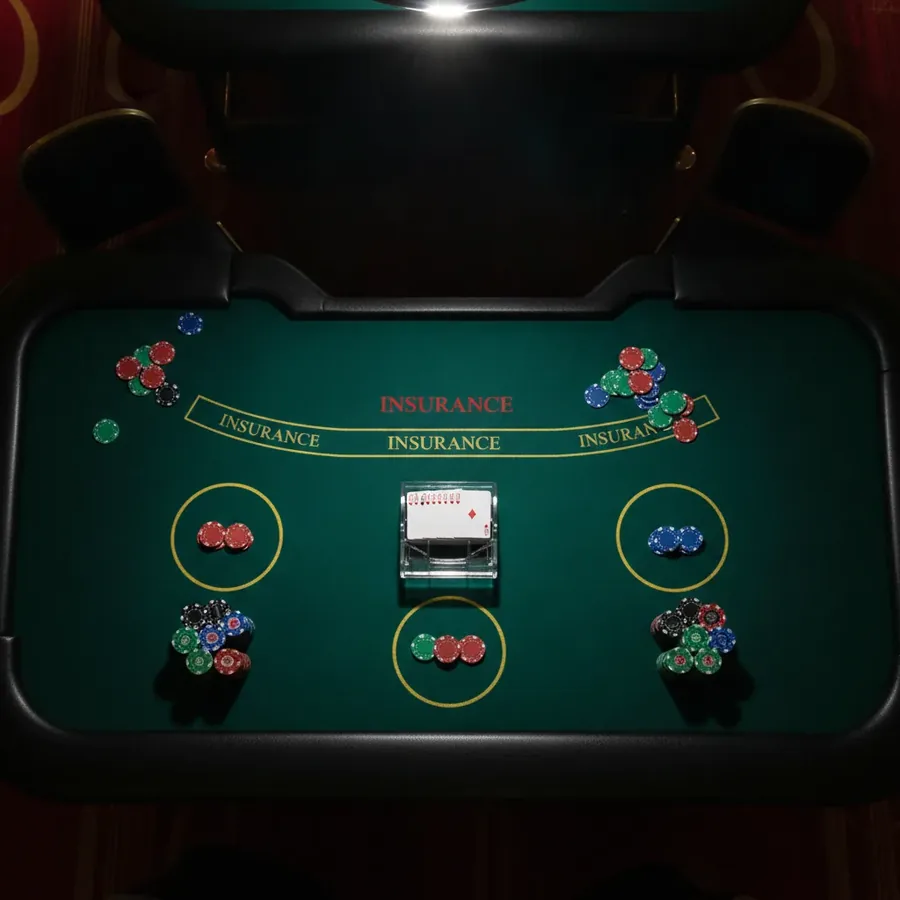
Insurance is a side bet paying 2:1 if the dealer has a natural blackjack when showing an ace. Despite the attractive payout ratio, this wager carries a house edge of 7.47% across six to eight decks. Basic strategy dictates always rejecting insurance unless counting cards reveals a true count of plus three or higher.
A single-deck game lowers the insurance house edge slightly to approximately 5.88%, yet it remains unprofitable for average players. Even with reduced deck counts, the statistical probability favors the casino over the long term for this specific proposition. Players relying on intuition rather than card counting will consistently lose money placing insurance bets at King Billy tables.
Blackjack Insurance caps at fifty percent of the original main wager, limiting exposure during uncertain rounds against dealer aces. However, the negative expectation persists regardless of bet size due to the underlying probability distribution of remaining cards. Accepting insurance converts a likely win into a break-even scenario only when the dealer indeed holds blackjack.
Blackjack variants at a glance
| Variant | Payout | House edge | Rule | Bet range |
|---|---|---|---|---|
| Blackjack 6 Decks, S17, DAS, DOA, Auszahlung 3:2, Basisstrategie | 99.54% | 0.46% | Dealer steht auf Soft 17; Verdopplung auf jeder Zweierkarte; Verdopplung nach Split erlaubt; keine Aufgabe. Basisstrategie ist für diesen Wert zwingend | Blackjack 3:2, normaler Gewinn 1:1, Insurance 2:1 |
| Blackjack Surrender (Late Surrender) – Regel-Effekt | n.a. (Regel-Modifikator) | −0.08 Prozentpunkte | Spieler gibt Hand nach Dealer-Blackjack-Prüfung auf, verliert die Hälfte des Einsatzes. Verbessert RTP um ca. 0.08 Prozentpunkte. Early Surrender ist wesentlich wertvoller (bis −0.6 Prozentpunkte), aber extrem selten. | Rückzahlung 50% des Einsatzes |
| Blackjack Auszahlung 6:5 statt 3:2 (6 Decks) | 98.15% | 1.85% | Ersatz von 3:2 durch 6:5 fügt exakt +1.39 Prozentpunkte zum Vorteil des Casinos hinzu – stärker als jede andere Regeländerung. Bei $10 Einsatz zahlt Blackjack $12 statt $15. | Blackjack 6:5, Gewinn 1:1 |
| Blackjack Ein Deck, klassische Regeln, 3:2 | 99.85% | 0.15% | Weniger Decks = niedrigerer Vorteil; ein Deck gibt ca. −0.48 Prozentpunkte gegenüber 8 Decks. Oft durch 6:5 Auszahlung kompensiert. | Blackjack 3:2, Gewinn 1:1 |
| Blackjack Split / Double / H17 – Regel-Effekte | n.a. (Regel-Modifikatoren) | H17 +0.22 Prozentpunkte; RSA −0.08 Prozentpunkte; DAS −0.14 Prozentpunkte | Dealer Hits Soft 17 verschlechtert RTP um 0.22 Prozentpunkte; Resplit Aces verbessert um 0.08 Prozentpunkte; Double After Split verbessert um ca. 0.14 Prozentpunkte; 6 Decks statt 8 – ca. 0.02 Prozentpunkte. | Double – Einsatz ×2 mit einer Karte; Split – bis 4 Hände; Ass-Split meist mit einer Karte. |
| Blackjack Liberal Vegas Strip (liberale Regeln, 3:2) | 99.72% | 0.28% | Günstigste Regelkombination: S17 + DAS + Resplit + Late Surrender. Standardabweichung 1,15 | Blackjack 3:2, Gewinn 1:1 |
Blackjack Payout 3:2 Explained in Detail
The standard payout ratio for a natural Blackjack is 3:2, which translates to a specific monetary return on the initial stake. A 100 EUR bet yields a 150 EUR profit, whereas the inferior 6:5 variant reduces this to only 120 EUR for the same wager. This discrepancy adds exactly 1.39 percentage points to the house edge, significantly increasing the long-term cost of play.
The difference between the two payout structures becomes mathematically evident when comparing their respective Return to Player percentages. The 3:2 version maintains an RTP of 99.85% with a minimal house advantage of 0.15%, while the 6:5 format drops the RTP to 98.15%. Consequently, players facing the lower payout structure lose value at a substantially faster rate over extended sessions.
Regulatory frameworks and game design choices often dictate whether a table offers the favorable 3:2 or the predatory 6:5 arrangement. Players must verify the payout rules before sitting down, as no amount of skill can offset the structural disadvantage imposed by the reduced coefficient. Choosing tables with the higher payout remains the only viable strategy for preserving bankroll efficiency.
When can you increase your bet?
Doubling down allows a player to double their initial wager after receiving the first two cards, provided specific hand conditions are met. This move is permitted on any two-card total and also applies after splitting pairs, known as Double After Split (DAS). Utilizing DAS correctly can improve the overall RTP by approximately 0.14 percentage points compared to tables that forbid this action.
Players may split pairs to create two separate hands, effectively doubling their exposure to risk on identical starting values. Most variations allow resplitting up to four hands, though Aces are typically restricted to receiving only one additional card. Resplitting Aces specifically enhances the player's expected return by about 0.08 percentage points relative to non-resplit rules.
The decision to increase bets via doubling or splitting depends heavily on the dealer's upcard and the specific rule set employed. Hitting on Soft 17 (H17) negatively impacts the RTP by 0.22 percentage points, making conservative doubling strategies more critical. Accurate application of basic strategy during these doubling opportunities is mandatory to maintain the theoretical 99.54% RTP associated with optimal play.
Why Loss Progression Quickly Reaches Table Limit
Table limits define the maximum allowable wager, creating a hard ceiling that halts aggressive betting systems like the Martingale progression. For instance, Infinite Blackjack caps bets at 5,000 EUR, while Quantum Blackjack Plus Live shares this identical upper boundary. Once a losing streak forces the required bet beyond this threshold, the system fails completely regardless of subsequent wins.
Standard deviation measures the volatility of outcomes, with Liberal Vegas Strip blackjack showing a baseline of 1.15 units per hand. High-variance side bets such as Hot 3 or Bust It introduce further unpredictability, accelerating bankroll depletion during negative cycles. The combination of high variance and fixed table limits ensures that exponential betting strategies inevitably collide with operational constraints.
Live dealer environments like Evolution's Infinite Blackjack offer unlimited seats but enforce strict monetary boundaries on individual wagers. A player attempting to recover losses through doubled bets will quickly encounter the 5,000 EUR cap if the losing sequence persists. This mathematical reality prevents any betting progression from guaranteeing profit, as the house edge remains constant regardless of stake size.
Surrender vs Playing Out on 16 vs 10
Late Surrender permits a player to forfeit half their bet after the dealer checks for blackjack, reducing the immediate loss on weak hands. This rule improves the RTP by approximately 0.08 percentage points compared to games without surrender options available. It serves as a crucial defensive mechanism when holding a stiff hand against a strong dealer upcard like a ten.
Early Surrender is significantly more valuable, potentially improving RTP by up to 0.6 percentage points, yet it remains extremely rare in modern casinos. Since Late Surrender occurs only after the dealer verifies they do not have a natural, its protective value is notably diminished. Players should prioritize tables offering this feature to mitigate losses on statistically doomed hands against ten-valued cards.
The mathematical advantage of surrendering becomes most apparent when comparing the expected value of playing out versus cutting losses. Holding a 16 against a dealer 10 represents one of the worst starting positions in blackjack, where the probability of busting is high. Accepting a 50% refund through surrender preserves capital better than risking the entire stake on a likely failure scenario.
How long does a Live Blackjack round take?
The Infinite Blackjack table by Evolution allows unlimited seats with bets ranging from 1 to 5,000 EUR. This structure supports continuous play without waiting for empty chairs, unlike standard tables limited to nine players. Players can join the action immediately as cards are dealt to a split dealer hand.
Quantum Blackjack Plus Live by Playtech operates on a similar high-stakes range of 1 to 5,000 EUR per round. The game integrates quantum multipliers up to 1,000x on specific three-card combinations totaling 21 points. This feature adds variable payout potential without significantly altering the base duration of each dealing cycle.
Standard rounds at these live tables typically last between 30 and 45 seconds per deal depending on side bet complexity. Insurance wagers or complex multiplier checks may extend the processing time slightly before the next shoe begins. Players must place all initial decisions before the dealer reveals their hole card to maintain this pace.
Place Side Bet before cards are dealt
Infinite Blackjack offers four distinct side bets: Any Pair, 21+3, Hot 3, and Bust It. These optional wagers sit alongside the main hand and require separate funding before the cards are distributed. The primary game maintains an RTP of 99.47% when played with optimal strategy.
Insurance is a separate side bet paying 2:1 if the dealer holds a blackjack, but it carries a house edge of 7.47%. This wager is only available when the dealer shows an Ace and reduces the overall return to 92.53%. Basic strategy dictates always declining insurance unless counting cards reveal a true count of +3 or higher.
Blackjack Party by Evolution focuses on entertainment with two moderators rather than complex side bet matrices. Bets range from 1.000 to 1.000 EUR, emphasizing high-limit social interaction over statistical variance. Players place their main stake before the deal, keeping the side bet options minimal compared to other providers.
Error insurance: 7 percent additional house edge
Taking insurance on a standard six-to-eight deck game increases the house edge to exactly 7.47 percent. This metric represents the average portion of the wager the casino retains over hundreds of thousands of hands. The theoretical return drops sharply to 92.53 percent, making it one of the worst bets in the lobby.
Compared to the main blackjack game which often exceeds 99 percent return, the insurance side bet is statistically inferior. A player betting 100 EUR on insurance loses approximately 7.47 EUR on average per session volume. This loss rate far exceeds the typical variance found in standard table games like slots or roulette.
Early surrender rules can improve overall game RTP by 0.08 percentage points, but do not offset insurance costs. Since basic strategy advises against taking insurance except in rare counting scenarios, most players incur this penalty. The 7.47 percent edge remains fixed regardless of the number of decks used in the shoe.
Limits on insurance wagers typically cap at 50 percent of the original main bet amount. This restriction prevents players from fully hedging their exposure during favorable deck compositions. The payout ratio stays constant at 2:1, ensuring the mathematical disadvantage remains consistent across all stakes.
Unlimited seats via a split dealer hand
Evolution's Infinite Blackjack utilizes a split dealer hand to accommodate an unlimited number of players simultaneously. This technology allows any user to join the table without waiting for a seat to open up. The minimum bet starts at 1 EUR, while the maximum limit reaches 5,000 EUR per round.
Traditional physical tables restrict participation to nine players due to physical space constraints around the felt. Digital infinite versions remove this bottleneck by dealing multiple hands concurrently from a single shoe. This efficiency reduces idle time between rounds and accelerates the overall flow of gameplay for everyone involved.
Quantum Blackjack Plus by Playtech also supports high limits up to 5,000 EUR with similar unlimited seating capabilities. The game applies quantum multipliers to winning hands, adding excitement without restricting table capacity. Players benefit from immediate access to high-roller stakes that are rarely available at land-based venues.
When does the table max bet apply?
The maximum bet limit at Infinite Blackjack stands at 5,000 EUR per round according to Evolution specifications. This ceiling applies to the total wager including any side bets placed on the same hand. Players exceeding this threshold will have their excess funds returned or rejected by the system.
Quantum Blackjack Plus Live by Playtech shares the identical 5,000 EUR maximum stake limit per round. High rollers can utilize the full quantum multiplier potential up to this financial boundary. The limit ensures responsible gaming controls while accommodating significant bankrolls for premium table games.
Blackjack Party by Evolution imposes a stricter upper bound of 1,000 EUR per round despite its party atmosphere. This lower cap distinguishes the social format from the high-stakes infinite variant offered by the same provider. Participants must adjust their betting strategies to fit within this more restrictive financial framework.
Contact
Live - online chat
Banking









Providers












King Billy Casino 2026